

Automotive Engineering Projects
RV Project
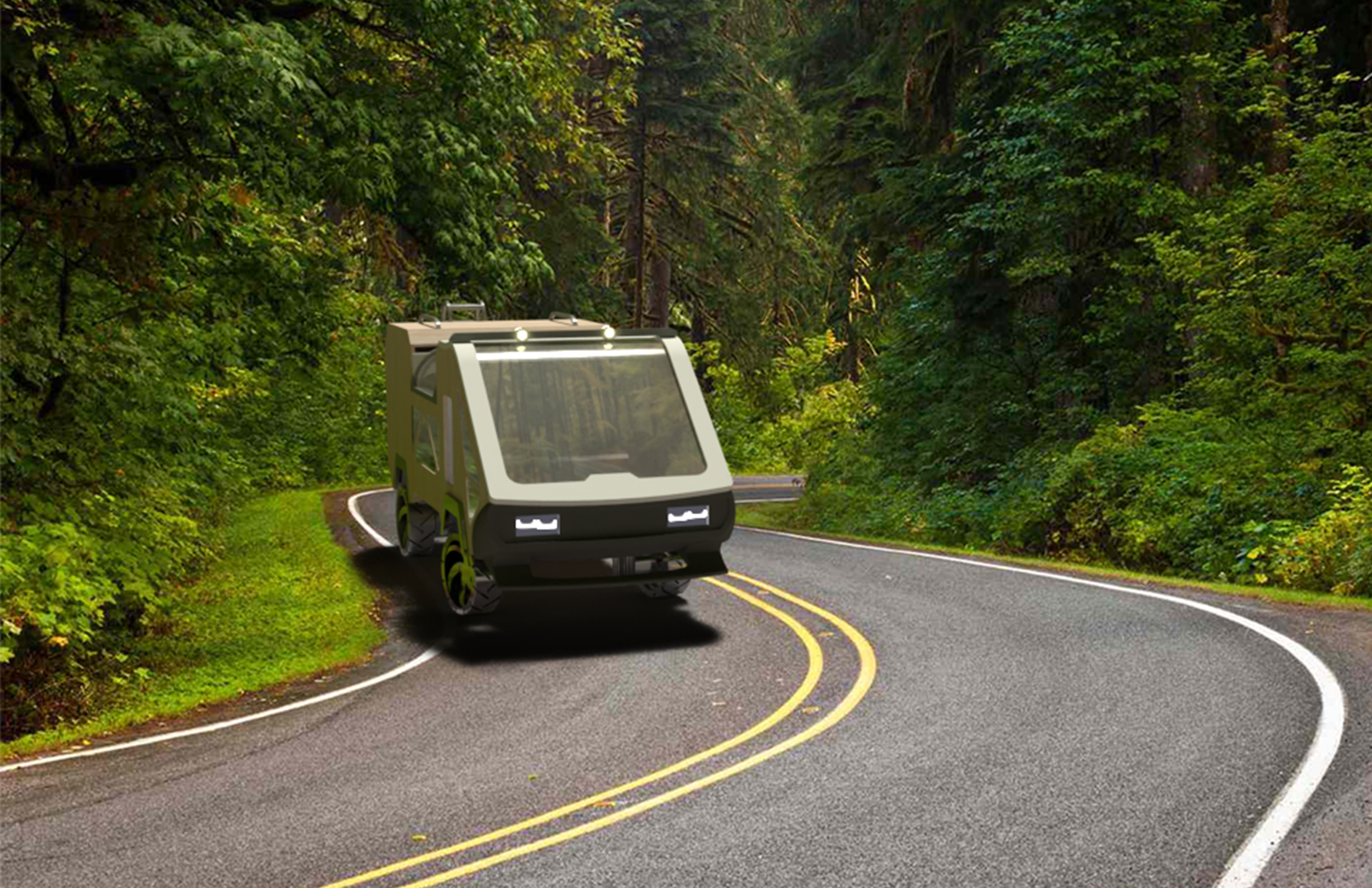
I designed this concept RV for the 2024 Technology Students Association.
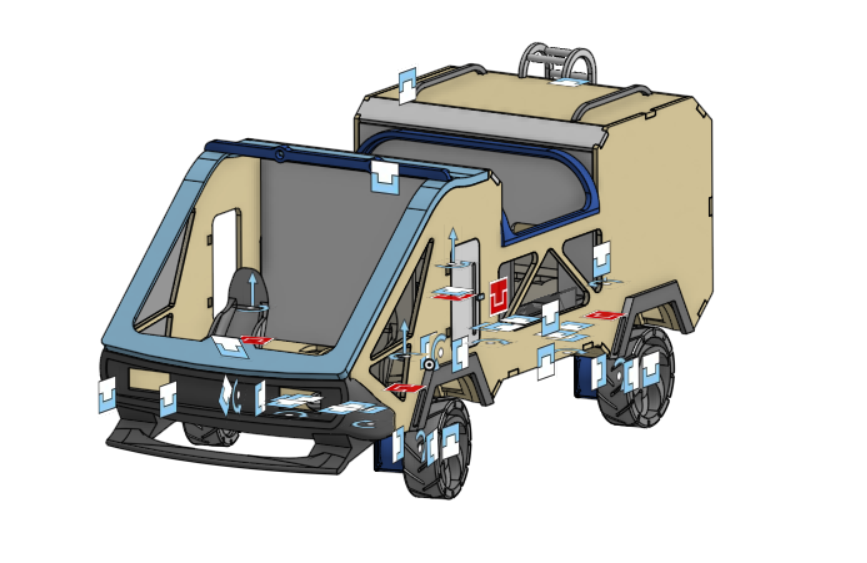
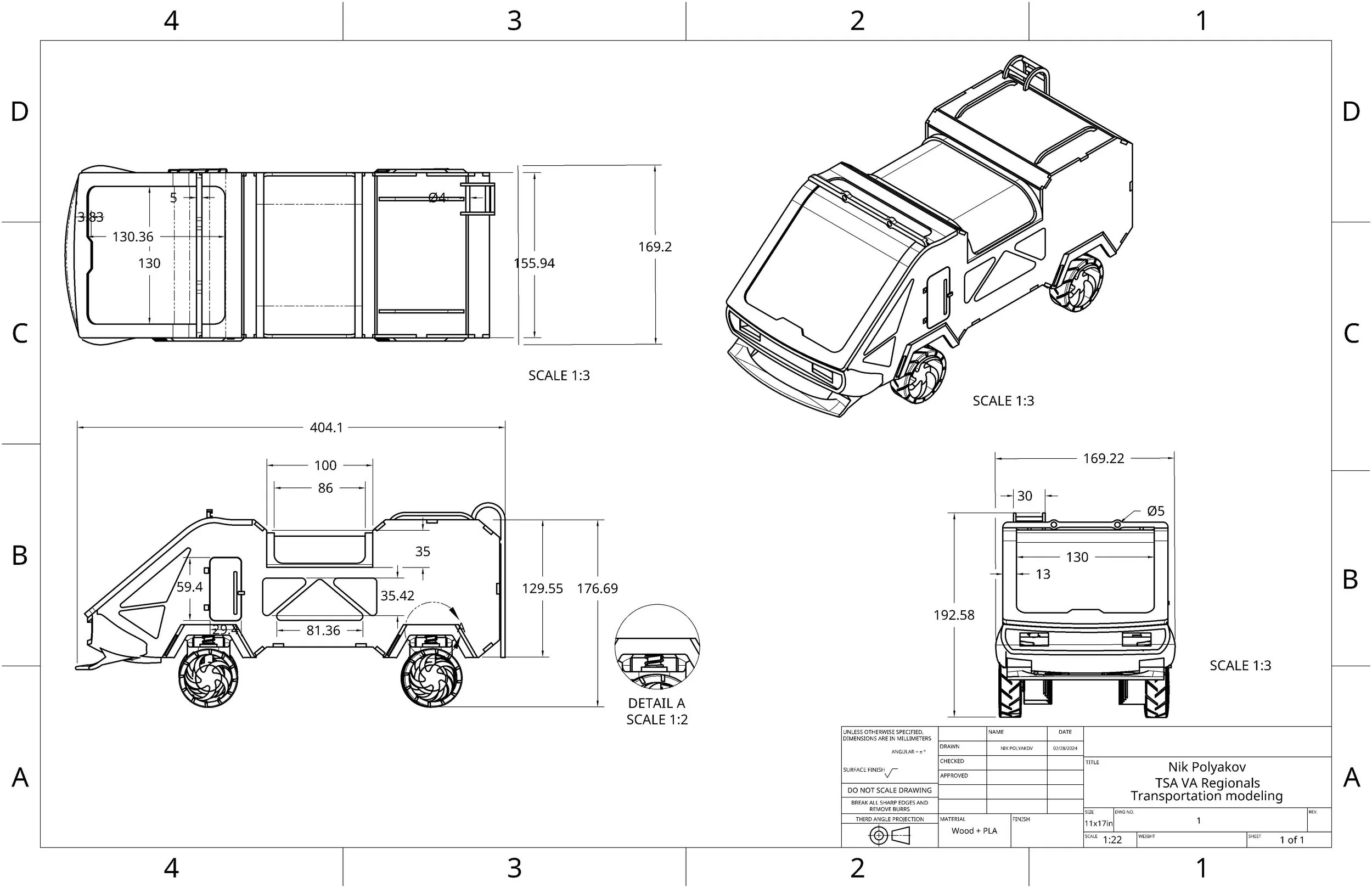
The Orthographic/Isometric sketches are to scale of the physical model I made, which includes active and individual steering and power as well as suspension on each wheel, smart pixel headlights for increased communication between other vehicles and pedestrains, an electrochemically darkening canopy, and autonomous power system. The wheel covers also have vents that redirect air to cool the brakes and motors under high speed, and a front wing which prevents the steering from feeling lighter at high speeds due to high-pressure air accumulating under the chassis.
The physical model was 15.9 inches long, with main panels made out of laser-cut birch, windows out of laser-cut plexiglass, and additional parts, including the wheel assemblies out of carbon fiber-reinforced PLA 3D prints. There is an optional ladder on the back and rails on the top to mount various attachments.
In addition to the aforementioned mechanical benefits, this RV is also designed to use a Hydrogen Fuel Cell. Although fuel cells are not as energy efficient as batteries, their production does not pollute the environment, so they would result in much more long-term sustainability. Using solar panels, the RV could also stop next to a body of water and use electrolysis and energy from solar panels to convert water into Hydrogen fuel without any emissions.
I designed this in OnShape and AutoCAD, using the Universal Laser Systems software and Ultimaker Cura to manufacture the pieces.
Scrambler
Scrambler was an event in the 2023 and 2024 Science Olympiad, with more than 7,800 teams competing from all 50 states and Japan. The task was to create a device that uses a launcher fitting into a 100cm x 100cm x 50cm prism, solely gravitational energy with a maximum 1.5kg falling mass, to accelerate a cart with an egg on the front around a bucket and stop at a precise distance anywhere from 8-12m as fast as possible.
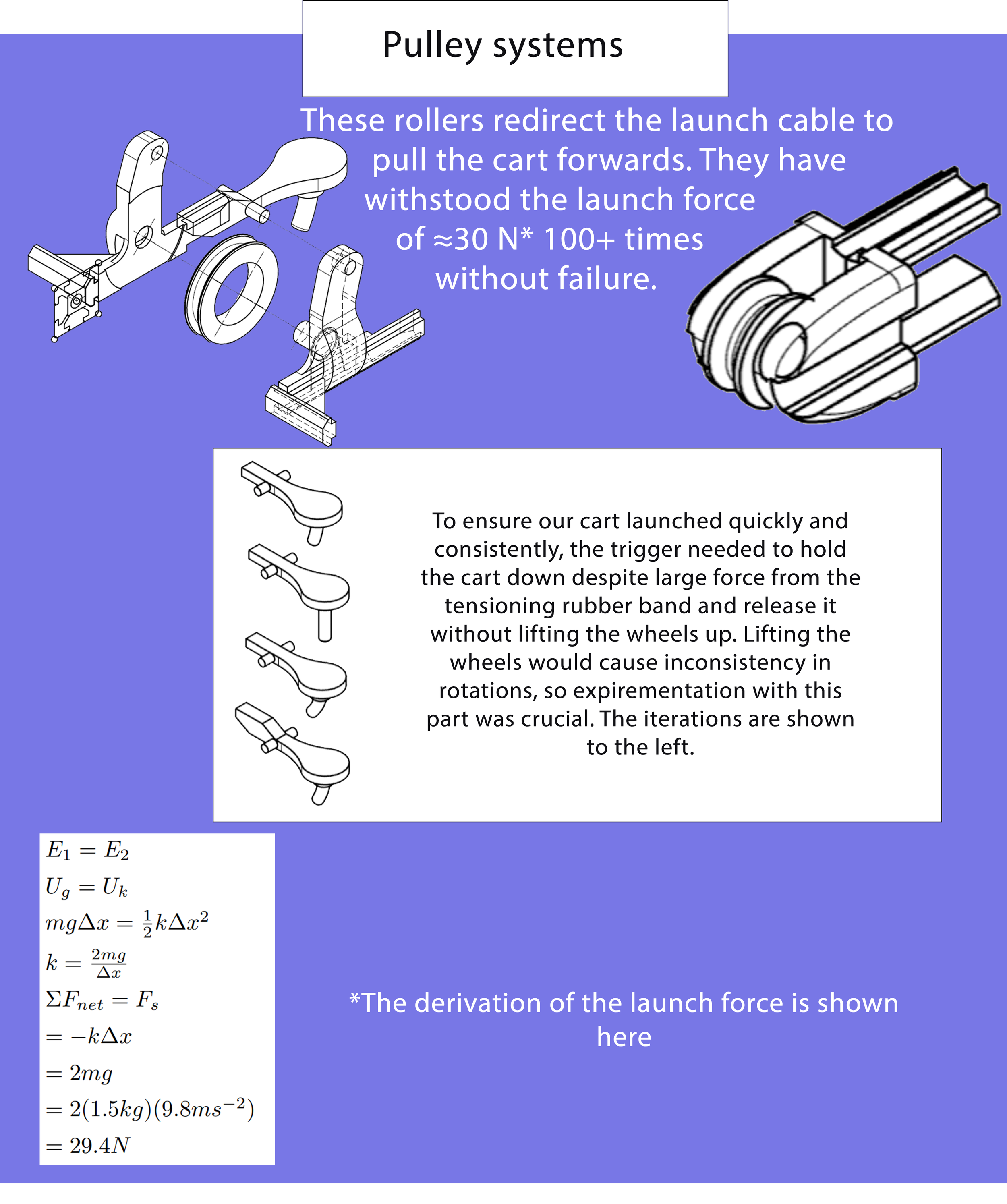
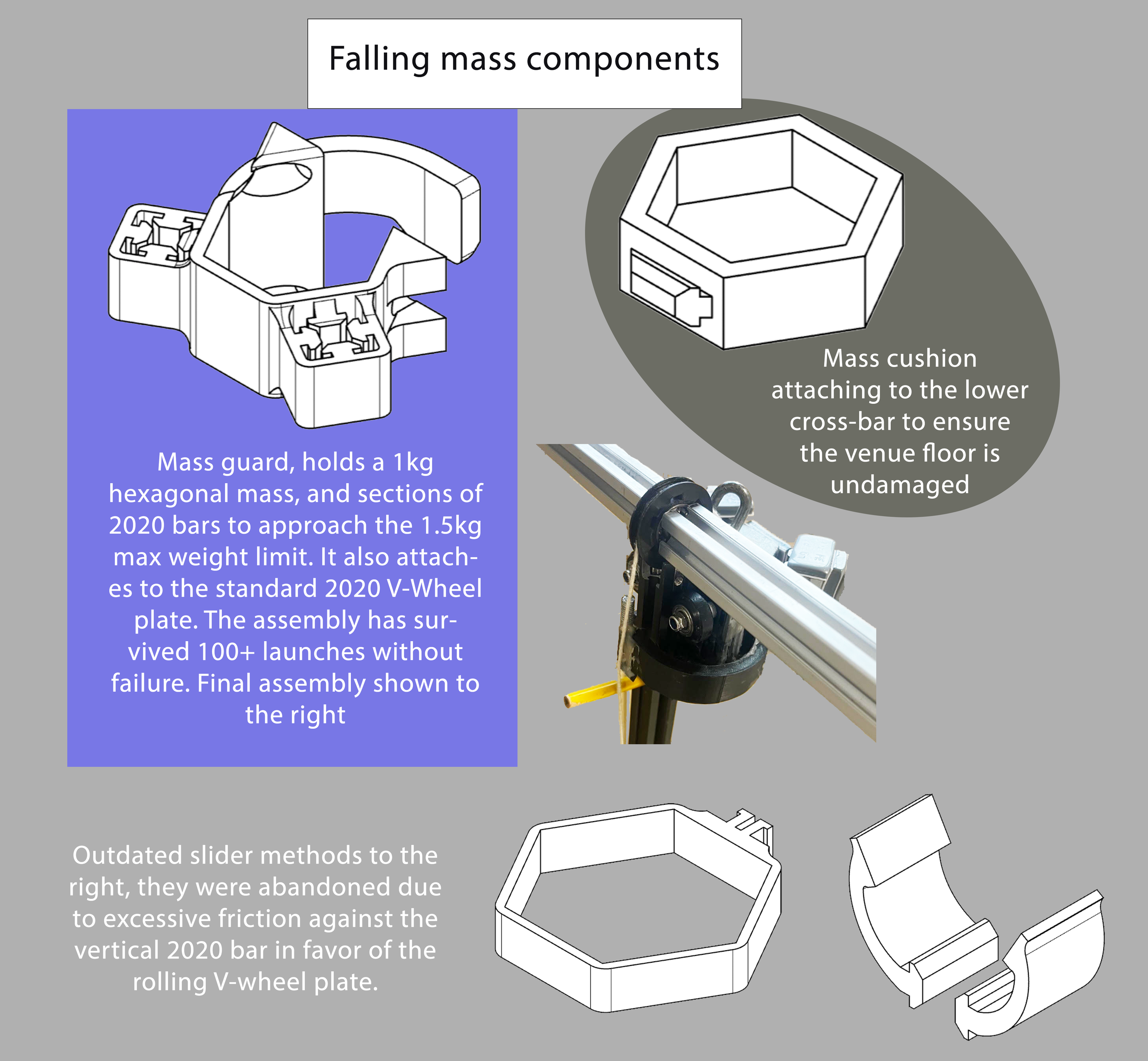
For my design, I noted that the most common system of a falling mass propelling a cart with a pulley would be inefficient because the mass would hit the ground with kinetic energy remaining. Instead, I designed a system where the mass fell and tensioned a rubber band as it descended, and then triggered a launching mechanism to propel the cart when it reached the very bottom of the device. This ensured that the mass hit the cushioning mat with nearly no kinetic energy, and all of its gravitational potential got converted into propelling the cart. This design allowed us to complete the 7.5m long timing track in 1.8 seconds at the 2024 Virginia State Tournament, approaching the national record of 1.6 seconds.
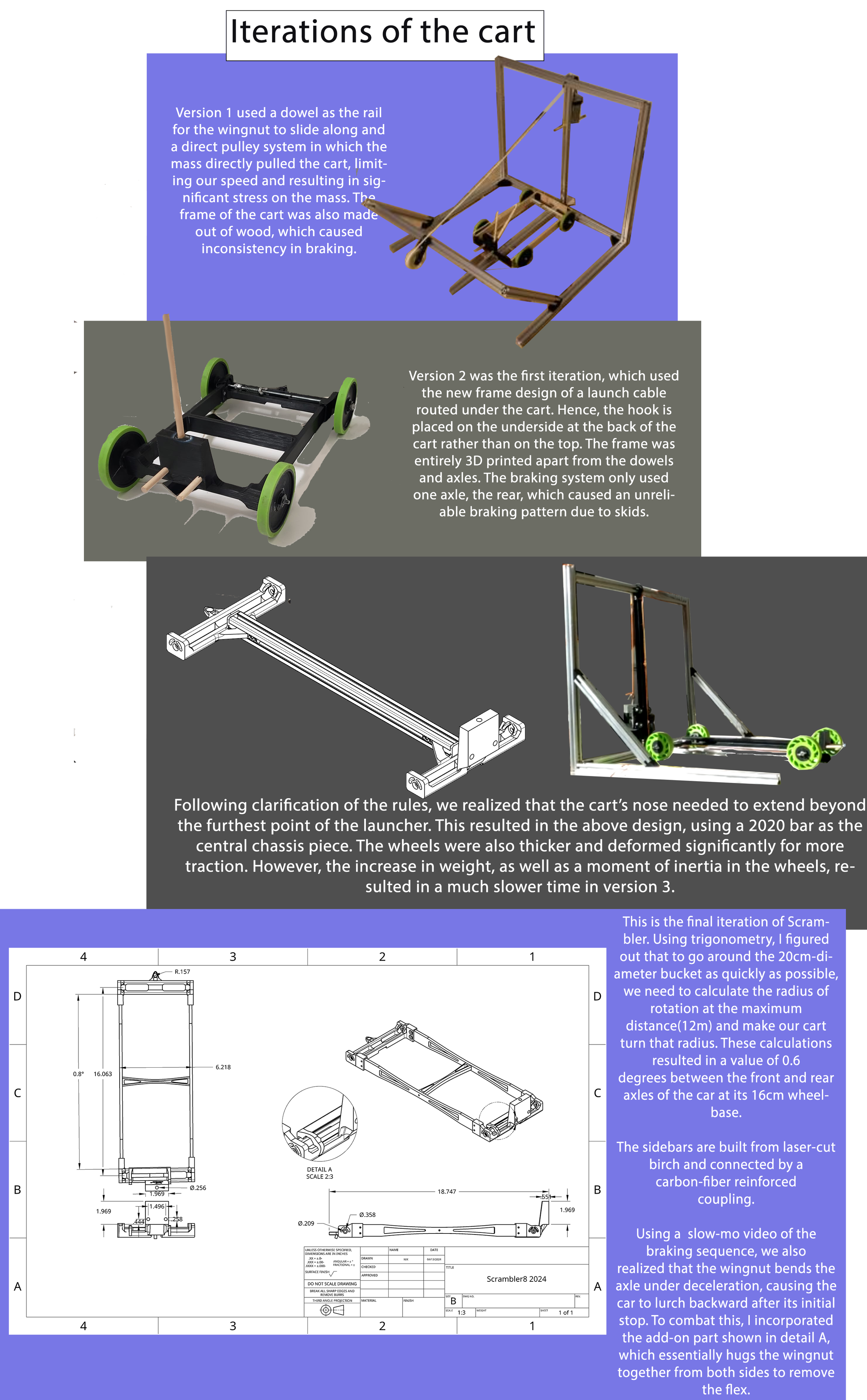
The cart itself needed to adhere to strict engineering standards, with around 14 specific parameters describing the wheelbase and backstop holding the egg needing to be precisely met to avoid penalty. The cart used a threaded rod as its axle, with a wingnut placed on the rod, traveling along a rail to lock the axle when it reached a specific rotation. However, due to our high speed, this system proved ineffective because the cart’s wheels would lock up and send it into an unpredictable skid depending on the differing surfaces of our competition venues. To counter this, my partner and I implemented the same system on the rear axle, except with a spring between the fixed nut and the wingnut, to provide a gradual decrease in speed before the locking of the front axle. This has allowed us to have extreme consistency, with us stopping 6.5cm away from the target at the 2024 Virginia State tournament.
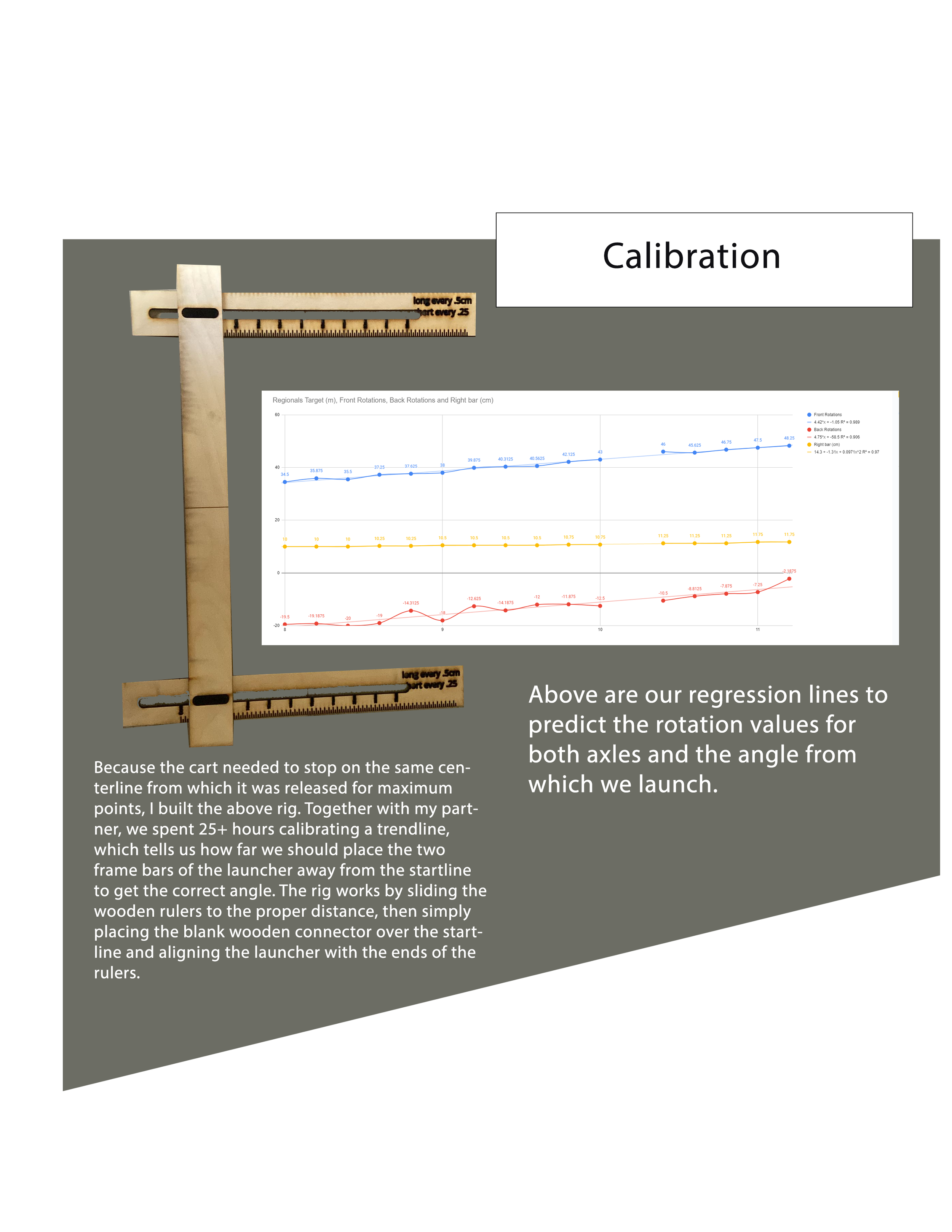
To ensure we knew the rotations for each axle and how much we should angle the launcher to make our cart stop on the centerline, we performed hours of calibration and produced the linearized data shown to the left. The functions displayed allowed us to predict target rotations and angle settings for any possible distance in our range.
The cart was built using FDM 3D printing, graphite-lubricated bearings, aluminum threaded rods, wingnuts, laser-cut birch bars, and wooden dowels. The launcher was made using 2020 aluminum bars, the 2020 V-wheel slider, and various 3D-printed attachments.
Awards:
3rd place 2024 National Tournament @ Michigan State University
1st place 2024 Fairfax Invitational
2nd place 2024 Virginia States @ UVA (Sponsored by Northrop Grumman, Aurora Flight Sciences)
3rd place 2024 Yale Invitational, 2024 Fairfax Regionals
4th place 2023 Fairfax Regionals
6th place 2023 Virginia States @ UVA (Sponsored by Northrop Grumman, Aurora Flight Sciences)
22nd place 2023 National Tournament @ Wichita State University, Kansas